How many times did you agree to do something – because you were terrified that the other person would be angry with you if you said no?
That’s me. And it might not even be the fear of angering the other person. It might be the fear that my friendship with the other person might diminish, or that the person might seek a retributive “no” to me later on, or just even that the person might bear a secret grudge that will explode at a later stage.
The thing is – people pleasing means reducing your authenticity. Approval addiction is as debilitating as any other type of substance abuse, and it hurts yourself – your authentic self. The bottom line is – when you fear the loss of someone’s approval, it stops you from being authentic.
Which is a huge, inefficient waste of time.

The hidden cost of approval addiction
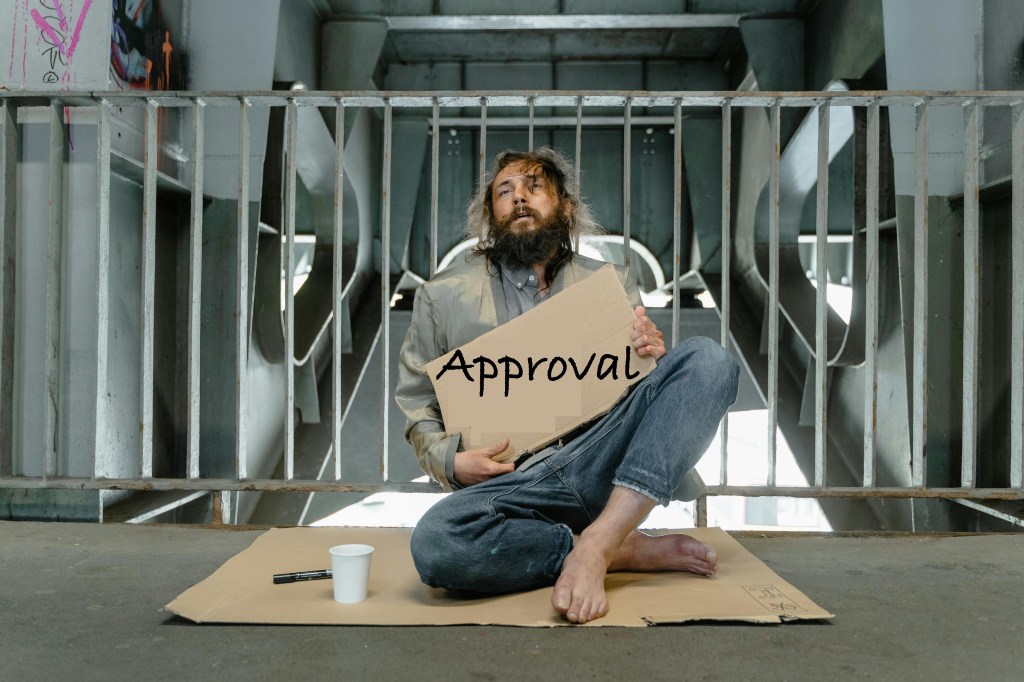
Approval addiction isn’t this catchy alliteration I came up with – it’s really a thing. There are also other psychological terms to describe it – the false self, self-alienation, or fear of disapproval.
Approval addiction is an unhealthy need for affirmation. Let me be clear – affirmation is good, it builds confidence. But it’s the dose that makes the poison. When your need for affirmation reaches unhealthy levels, it’s approval addiction. It means you are not capable of feeling good about yourself, that you don’t have your own self-worth, and that you can’t find the approval within yourself to just be.
The cost is obvious – stress from constantly trying to live up to expectations, anxiety from falling short in the eyes of others, and the absence of psychological safety. The constant self-monitoring leads to decision fatigue and a lack of authenticity.

Why is authenticity so important anyway?
Higher authenticity correlates with greater psychological wellbeing, meaning that the more authentic you are, the better you can be – and the more you can do.
But what does it mean to be authentic?
Basically it means to speak your truth. It means to stop pretending you like or dislike something. It refers to behavioural congruence, which is have consistency between what you feel internally and what you do externally.
Authenticity requires a certain level of self-awareness and objectivity in processing information about yourself. But that’s another topic for another day. Just remember that approval addition diminishes authenticity.
If you come from a place of authenticity, then you stop wasting energy pretending to be something you’re not. You direct that energy towards what matters.
And when energy and intention align, productivity skyrockets.
You see, authentic actions – performing tasks that align with our values and strengths – creates conditions for flow. Flow in the sense defined by Mihaly Csikszentmihalyi – a mental state of complete absorption in an activity. When you feel fully focused, energised, and engaged. An optimal experience where skill and challenge are perfectly matched.
You won’t have to push through the day – because authenticity will pull you through the day.
I know that it’s scary to be authentic. That fear comes from a place of insecurity and self-doubt. But the thing is, authenticity counteracts that. Authenticity boosts self-esteem, pursuit, and persistence – because you’re more likely to stick with a goal when it’s your goal. It makes you more confident, ethical, and resilient.
Authenticity is the panacea to that insecurity and self-doubt that prevents you from being authentic in the first place.

How does approval addiction show up?
You might not think you are a people pleaser. But have you ever done any of the following?
- Saying “yes” when you mean “no” because you’re scared of disrupting the peace, a relationship, or a situation you’re in
- Keeping quiet when you have something to say, because it might sound stupid or you might offend someone
- Over-preparing. Over-editing. Over-committing. Overdoing everything so that nobody can find fault with you.
- Not asking for help because you don’t want to irritate someone or be seen as incapable.
It means that there’s a lack of psychological safety and you don’t dare to speak up. This prevents ideas from flourishing, because it usually isn’t a single solution that solves the issue. It’s the co-creation and innovation that helps ideas and solutions to iterate and flourish.

Baby steps for being authentic
Being authentic doesn’t mean screaming out your deepest truths to all and sundry. Just as you need incremental improvements to be able to do the splits, take small advancements towards authenticity with the following.
1. Ask yourself where the “yes” is coming from.
The next time you say yes to something, stop and ask yourself. Are you doing this because you want to be liked or because it matters to you? Don’t outsource your self-worth by doing things you don’t like.
2. Practice “micro-authenticity”.
Start having small moments of honest expression. It could be as small as disagreeing (scary, I know!) respectfully with a popular opinion. Perhaps you might want to share a personal anecdote in a discussion. Or ask a question that you think is dumb, that nobody else has asked. These will build confidence in self-expression, as well as forging connections by being vulnerable.
3. Imagine your best possible self.
Visualise your ideal future self by using th Best Possible Self technique. It improves optimism and motivation, and more important, gives you a direction to be authentic in. By imagining your ideal future self, you know the person you truly want to become – and the steps you need to take to get there.
4. Align tasks with values.
Identify your values (or use a strengths test like the VIA Character Strengths Survey or Gallup StrengthsFinder to discover those). Then proactively design ways to bring as many of those into your day as possible. Even if you can only do one or do things, it’s a start. It will help align your actions to your values, and develop authenticity.
5. Create safe spaces – for yourself and others
Share your failures. Invite honest feedback (but be prepared for it!). Normalise being imperfect and not knowing everything. It creates psychological safety, which fosters authenticity for both you and the people around you.

Authenticity is a productivity multiplier
Approval addiction is exhausting but safe.
Authenticity is productive but scary.
Which would you rather be?
The thing is, when you start behaving and living in a way that’s aligned to you – you get back energy, time, and creativity. Authenticity is efficiency. It prevents you from overcommitting, burnout, and decision fatigue. It creates deep focus, better relationships, and more meaningful success.
Yes, it’s terrifying. What if the person gets angry?
Yes, it feels indulgent. Am I a special snowflake for wanting what feels aligned?
Yes, it feels uncertain. What if this doesn’t work?
And with all change, it requires some adjustment time and may cause some friction. You may lose familiarity. But you gain alignment. You gain situations, people, and actions that are authentic for you. You can let go of familiar, good things – to make way for new, better things.
So this week, ditch one people pleasing act. Set one boundary.
You’ll find freedom, flow, and better productivity.

After all, you know what they always say in movies.
Be yourself.

 Happiness for Busy People
Leave a reply to Why your boundaries need border control (and maybe a visa application too?) – Happiness for Busy People Cancel reply