
I used to think mindfulness was useful only in small doses. Helpful for a short while, but not great in quantities. People who openly preached and espoused mindfulness felt ungrounded, and not very productive to me.
Then I had to write an assignment about Mindfulness Psychology for my Graduate Diploma in Applied Positive Psychology. I had to do a deep dive into mindfulness, its origins, its applications, its benefits. When I read the science about it, it changed my mind about mindfulness. At the end of the assignment, I made a promise to write about it on Happiness for Busy People one day – to write about the brain hack that is mindfulness.
So here it is!

From being “mind full” to mindful
If you told me a few years ago that mindfulness would be a productivity hack, I would have laughed. I thought that mindfulness was for yoga studios or meditation retreats. It was great for relaxation, but relaxation is the opposite of productivity.
Somehow, I started using mindfulness apps like Calm and did the Positive Intelligence programme, which introduced me to mindfulness practices. I learnt about polyvagal theory as part of Pilates curriculum writing work, which gave me the cognitive foundation for nervous system science.
I also did the above-mentioned module on Mindfulness Psychology (at the time, I couldn’t believe that there was enough material for an entire module). And that was when it helped to pull all these disparate pieces of information, all these scattered skills and knowledge about mindfulness together for me. That’s when it turned a “mind full” of knowledge, into mindful knowledge.
I discovered how mindfulness was actually a huge lever for efficiency.

How mindfulness rewires the brain
Our brain has different brain networks – networks of discrete brain regions that are functionally connected – to perform different cognitive tasks. Different networks activate when it comes to attention, processing information from the senses, reasoning, and other functions.
The Default Mode Network, as researched by Marcus Raichie and Abraham Snyder, is the part responsible for mind-wandering and distraction. What’s mind wandering? It’s thinking about the past, future, or random self-judgements. It’s this mental “background noise” that impacts focus and clarity.
Mindfulness reduces activity in the Default Mode Network, resulting in less mental “background noise” and more focused, efficient thinking. Over time, it helps to rewire the brain for better attention and mental clarity.
Sidebar: The Default Mode Network isn’t inherently positive or negative, but that’s beyond the scope of this article.
Mindfulness also strengths the “top-down” pathways (how we focus attention and make decisions) and “bottom-up” pathways (how we process sensory information). It also physically increases cortical thickness in areas linked to attention and emotional regulation, as discovered by Sara Lazar’s research – which literally means that mindfulness gives you a big brain.
So to sum up, mindfulness improves your brain by:
- reducing Default Mode Network activity
- strengthening “top-down” pathways for attention and decison-making
- strengthening “bottom-up” pathways for processing information
- increases cortical thickness in brain areas for attention and emotional regulation
Basically, the time spent being mindful pays dividends in making you more efficient in your tasks.
The polyvagal connection – mindfulness and the nervous system
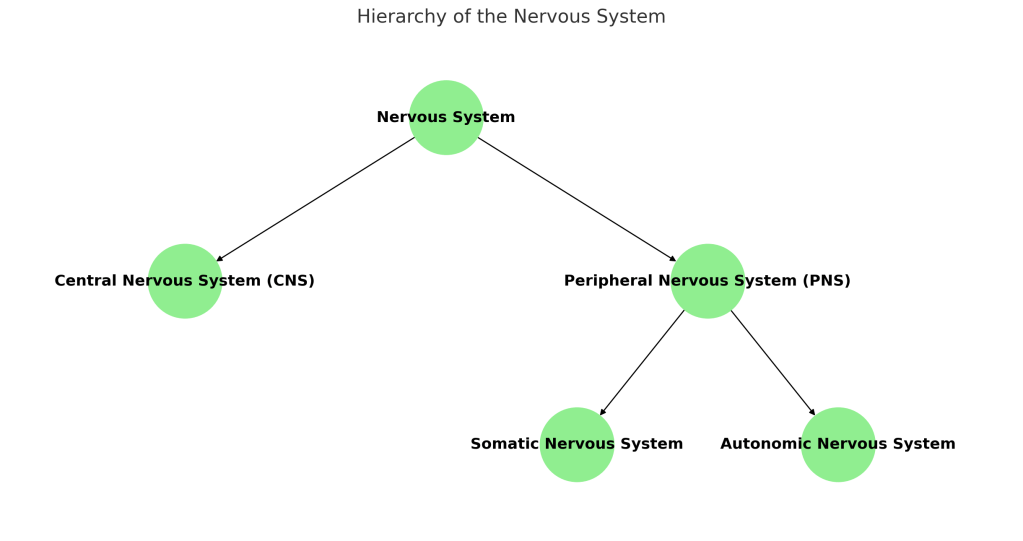
Mindfulness also helps you to hack your body when it comes to the nervous system. Our nervous system is broadly divided into the central nervous system (the brain and spinal cord, which governs functions like information processing and decision making) and the peripheral nervous system (the network of spinal and cranial nerves, which governs functions like sensory input and processing environmental changes).
Under the peripheral nervous system are two more systems – the somatic nervous system (which has voluntary control of the skin, joints, and muscles) and the autonomic nervous system (which has involuntary control of the internal organs, blood vessels, smooth and cardiac muscles).
The autonomic nervous system is what we’re looking at. It regulates involuntary physiologic processes including heart rate, blood pressure, respiration, digestion, and sexual arousal. And because it’s involuntary, we can’t quite mentally will it to do what we want.

In polyvagal theory, the autonomic nervous system is classified into three general settings – dorsal vagal, sympathetic, and ventral vagal.
The ventral vagal state is what we’re looking at – the “rest and digest” state. It is associated with calm, safety, and connection. It’s a mode with indicators like deeper breaths, slower heartbeats, better digestion, and less dilated pupils. To be very clear, it is a more desirable state if you are not in danger.
Since it’s involuntary, we can’t make ourselves go into it… unless we hack it with mindfulness. Deep breathing, meditation, and gentle movement activate the ventral vagal system, giving us the ability to shift from stress to calm in a few minutes, meaning we can make better decisions from a place of better objectivity.
Mindfulness improves both the body and the mind.

Practical mindfulness interventions for very busy people
These are the three mindfulness interventions I recommend, mainly because they’re convenient and effective.

1. Ladder breathing (long exhales)
This is a breathing exercise which emphasises breathing out. For starters, you can:
- breathe in for 4 counts
- hold for 4 counts
- breath out for 8 counts
to get used to this form of breathwork. Once you’re used to it, you can breathe at your own pace – but focus on breathing out for as long as possible. This activates the ventral vagal system, which translates into the productivity gains shown above.

2. Savouring
This is a positive psychology intervention that I also use in other contexts. It means to deliberately notice and enjoy positive experiences. In particular, it helps you to notice nuances and details, which helps give you more information (or be efficient about extracting the information) from the task at hand.
It can be used mainly for eating and drinking – to taste the different flavour profiles and notes in your meals and food. It’s also good when you’re walking through a new environment or you’ve done some online shopping – carefully noticing every detail of the experience or object also helps you to break down why it appeals to you (and hence, how you can make things appealing for other people too).

3. R.A.I.N.
This is heuristic for when you feel stressed. It stands for:
- Recognise what you are feeling
- Accept the feeling without judgement
- Investigate why the feeling is there
- Nurture yourself with kindness
It’s a form of resilience that incorporates mindfulness – and it helps you to recover from setbacks faster.

Mindfulness is a science-based approach for productivity
If you’re busy, you probably think that you don’t have time for mindfulness. And to some extent, that’s true – you don’t have time for a lot of things.
But mindfulness, like many other aspects of positive psychology, helps you be more efficient. It helps you to recover faster, focus better, and be more emotionally regulated. The time spent on mindfulness will pay for itself (and more) with the time saved on tasks.
It’s like deciding whether you want to use a buff in a game. You might need to spend time and resources on that buff – but you end up winning faster and taking less damage. Mindfulness is like that buff.
Mindfulness is that time expander that you never knew existed.
References


 Happiness for Busy People
Leave a reply to The 6 types of motivation and how to integrate it into lesson design – Fun to be Smart Cancel reply